Napa, Sonoma or Willamette: How the Three Regions Actually Differ
Ask which is better and you will get an answer about wine. That is the wrong answer. What actually separates these three regions is money, distance, and how far ahead you have to book.
Ask which is better, Napa or Sonoma, and you will get an answer about wine. That is the wrong answer, because it is not what the question is about. Somebody typing those five words into a search box has already decided to go somewhere. What they are really asking is which of these places will give them the trip they have been picturing, and that turns out to be a question about roads, booking windows, tasting fees and how much of a good day they are willing to spend in a car.
There is also a third region that almost never makes the comparison, roughly six hundred miles north, and leaving it out is itself a kind of answer. We are going to put it in.
Here is the short version, and then the long one.
Napa Valley costs two thirds more and holds together better than either of the others. Sonoma County is not a place, it is a dozen places, and half of it is in one of them. The Willamette Valley asks you to learn one grape properly, which is a better first trip than it sounds like.
One thing to clear away first, because it is the assumption that ruins the most itineraries. Wine country is now an appointment business in all three regions. Around four rooms in five want a booking in Napa, in Sonoma and in Oregon alike, and on walk-ins Napa is as open as Sonoma, about one room in five each, which is not the reputation Napa has. Nobody is casual anymore. Plan accordingly wherever you go.
Napa Valley, the one that rewards a plan
From the town of Napa up to Calistoga is a little over twenty miles in a straight line, about thirty if you start down in Carneros, and it is narrow enough in places that you can see the hills on both sides at once. Two roads run its length. Highway 29 carries most of the traffic and most of the famous names, and the Silverado Trail runs parallel on the eastern side, quieter, faster, and the reason experienced visitors look relaxed while everybody else sits in traffic outside Yountville at half past four.
That geography is the whole story, and it shows up in the data as tidiness. Of the 115 Napa wineries we publish, 92% sit within twenty miles of the town of Napa and not one of them is further than twenty-five. No other region on this page is anywhere near that compact. Napa is the only one of the three where you can pick a base badly and still recover.
What Napa charges for that is money. The median first tasting fee is $50, against $30 in both of the others, and 66% of Napa rooms open at $50 or more. Over a three-day trip with three tastings a day, that difference is most of a hotel night.
Napa has a reputation for being intimidating. We think that reputation is wrong, and it is worth saying so plainly. Napa is not intimidating and it is not unusually hard to get into. It is expensive, and expense reads as intimidation to a first-time visitor in a way that a booking requirement does not. The rooms are welcoming once you are in them. The bill is the part that surprises people.
What this means for your day
Book three tastings, not five. This is the single most useful sentence anybody can give you about Napa. A tasting here is frequently a seated, hosted, ninety-minute affair rather than a stand-up pour, and three of those with lunch in the middle is a full and genuinely pleasurable day. Five is a schedule, and you will spend it watching the clock and apologizing for being late to the fourth.
Pick a base town and stop driving. Napa, Yountville, St. Helena and Calistoga each anchor a different stretch of the valley. The compactness means this decision is forgiving, which is exactly why it is the one people put the least thought into.
Sonoma County, not a place but a dozen places
Sonoma is where the comparison usually goes wrong, because people treat it as Napa’s more relaxed neighbor. It is cheaper, certainly. The median tasting fee is $30 and 41% of the county’s rooms open at $25 or under, which is still the friendliest opening price of the three.
The thing that actually separates it is size. The two furthest apart wineries we publish in Sonoma sit 47 miles from each other, against 29 in Napa, and the county holds sixteen sub-appellations inside that span. Here is the part we should concede rather than let you find out: Napa has seventeen. The appellation count is not the difference. The distance between them is.
And then the fact that undercuts the whole “dozen places” framing, which is why we would rather print it than tuck it away. Of the 104 Sonoma wineries we publish, 54 are in Healdsburg. More than half the county’s tasting rooms, by our count, are in one walkable town. Sonoma is genuinely fragmented at the edges, with wineries scattered as far as 38 miles from that center, but the middle of it is more concentrated than its reputation suggests.
So the Sonoma mistake is not choosing a bad winery. It is treating the county as a single place, booking five good rooms that turn out to be forty minutes apart, and then spending the trip in the car being annoyed at a region that did nothing wrong.
What this means for your day
Pick your Sonoma first. Then pick wineries. In that order, always. Decide whether this is a Healdsburg trip or a Russian River trip or a coast trip, and let that decision do the filtering. If you have no strong feeling about which, take Healdsburg, because the numbers say you will spend less of the day driving and have more to choose from when you get there.
The other thing Sonoma does better than either of the others is groups. Of the three regions it has the highest share of wineries we have recorded as group-friendly, at 47% against Napa’s 34%. Combine that with a walkable plaza and Sonoma becomes the only one of these three where eight people can have a proper day without somebody drawing the short straw and driving.
The Willamette Valley, where one grape does the teaching
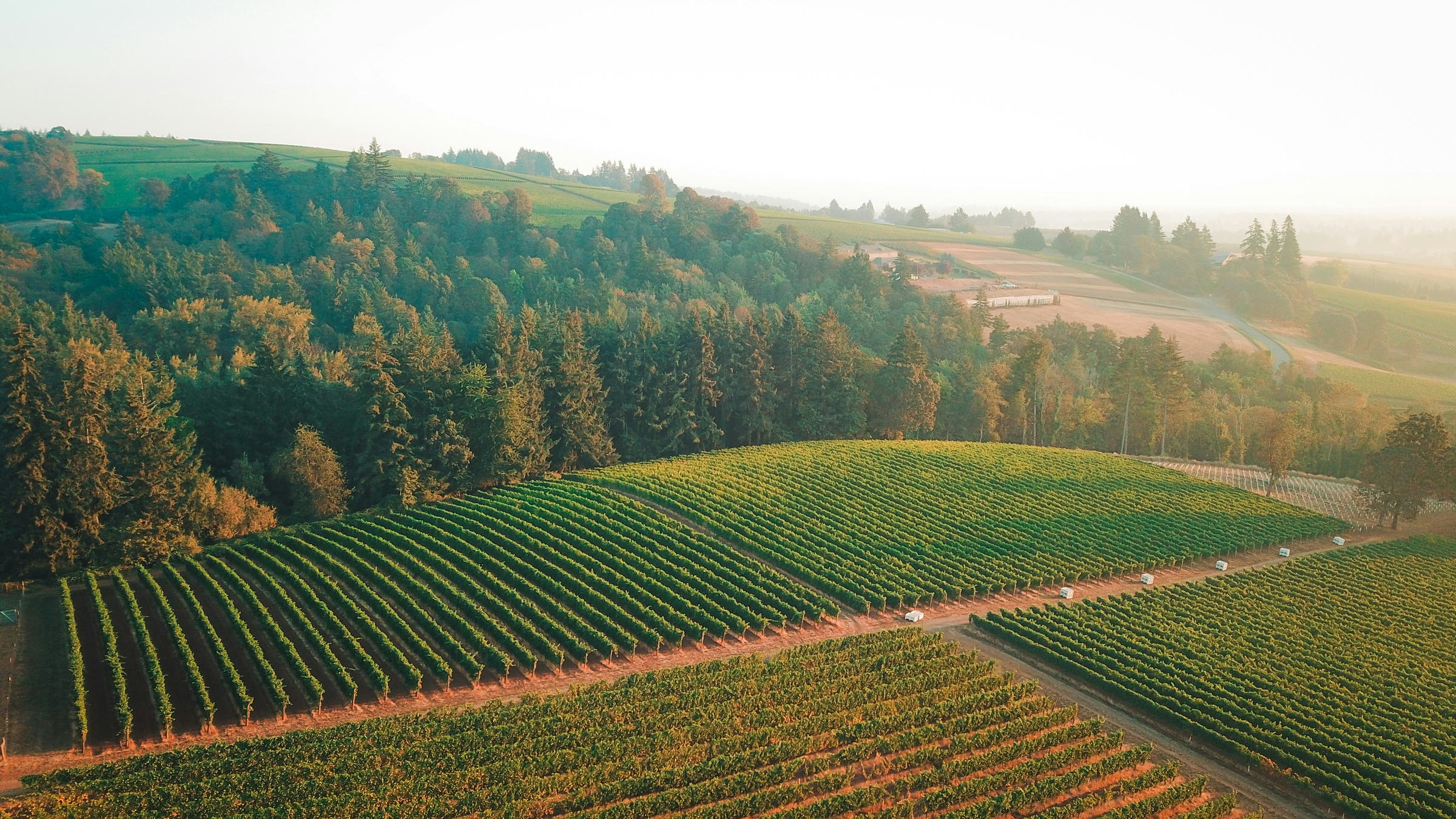
Drive forty minutes southwest out of Portland and the suburbs give way to hazelnut orchards, and then to hills with vines on them, and the whole register of the thing changes. The tasting rooms are smaller. The prices match Sonoma rather than Napa, with the same $30 median. And with reasonable frequency the person pouring your wine is the person who made it, which has become rare in California and is still ordinary here.
The standard objection is that it is all Pinot Noir. That is not an exaggeration and we can put a number on it: Pinot Noir is a primary varietal at 103 of the 120 Oregon wineries we publish, which is 86%. For comparison, the most planted primary grape in Sonoma appears on 37% of its rooms.
We think that concentration is the best argument for going, and specifically the best argument for going first. When every producer is working with the same grape across the same set of hills, the differences between them stop being abstract. You taste Dundee Hills against Ribbon Ridge in an afternoon and you can actually feel what people mean when they talk about soil, which usually takes years to click. Napa will teach you what you can afford. Oregon will teach you what you like.
Two things we should say against it, because they are true and because you would find them out anyway. Oregon is not the easy walk-up region it is sometimes described as. It has the highest share of appointment-led rooms of the three, at 82%, and the lowest share that welcome a walk-in. And the valley is long. Our furthest published Oregon winery sits 81 miles from Newberg, and the widest gap between two of them is 100 miles, which is the largest span on this page by a distance.
What this means for your day
Stay in the north. Base yourself in Newberg, Dundee or McMinnville and most of the region’s tasting rooms are a short drive away. The 100-mile figure is real but it describes the tail, not the trip you are going to take. Ignore the south on a first visit.
Then book. The smaller rooms mean that when a place does require a reservation, that reservation is genuinely limited rather than theater, and there is no queue to join if you get it wrong.
The comparison, in one table
This is the part to screenshot. Every figure is from our own published records as of 26 October 2026.
| Napa Valley | Sonoma County | Willamette Valley | |
|---|---|---|---|
| Wineries we publish | 115 | 104 | 120 |
| Median first tasting fee | $50 | $30 | $30 |
| Rooms opening at $50 or more | 66% | 25% | 20% |
| Rooms that welcome a walk-in | 20% | 20% | 18% |
| Rooms that prefer an appointment | 80% | 80% | 82% |
| Within 20 miles of the busiest town | 92% | 78% | 78% |
| Furthest room from that town | 24 miles | 38 miles | 81 miles |
| Recorded as group-friendly | 34% | 47% | 39% |
| Top grape, share of wineries | Cabernet, 70% | Pinot, 37% | Pinot, 86% |
| Days you need | 3 | 3 to 4 | 3, or 4 with the coast range |
| How far ahead to book | Weeks, months in fall | Days to weeks | Days, but the rooms are small |
| Busiest period | Harvest, roughly September to October | Harvest, but it disperses | Harvest, and it stays quieter |
| Easiest to get wrong | Overscheduling | Treating the county as one place | Assuming it is casual |
On dogs, which is the question we get asked more than any other: we did that one separately and properly. Of the 338 open tasting rooms across the three regions, 163 welcome a dog, and the Willamette Valley is the most welcoming by a distance. The full breakdown, and the nine wineries that put out a bowl, are in our dog-friendly wineries guide.
Which one suits the trip you are actually taking
You have never done this before. Sonoma, and stay in Healdsburg. It has the lowest opening fees alongside Oregon, over half its tasting rooms in one walkable town, and the highest group tolerance of the three, which also makes it forgiving of a couple who change their minds at lunchtime. Oregon is the strong second and the better trip if you would rather learn something than sample widely.
It is the two of you and it needs to feel like an occasion. Napa, and it is not close. The compressed geography that makes Napa expensive to fill is the same thing that lets you sleep, eat and taste inside a few miles, and the seated ninety-minute format that feels excessive on a casual visit is exactly what you want when the point is to be looked after.
There are eight of you. Sonoma. Walkable plazas solve the problem that kills group trips, which is not finding somewhere that will take eight people but finding somewhere that will take eight people without one of them spending the day sober behind a wheel.
You want to learn, not just drink. Willamette. One grape, one set of hills, and differences you can taste inside an afternoon rather than read about.
You have been to Napa and want the next thing. Willamette, not Sonoma. Sonoma is an adjacent version of a trip you have already taken. Oregon is a different one.
You want to turn up without a plan. None of them, honestly, though we have listed the Sonoma rooms that do take walk-ins. Four rooms in five want a booking in every region on this page. Napa takes walk-ins as readily as Sonoma, which is the single most counterintuitive number we have.
What each region gets wrong about itself
Every wine region has a story it tells visitors, and in all three cases the story is slightly out of date.
Napa sells prestige, and prestige is not what most people describe when they get home. The thing they describe is almost always a seated tasting where somebody had time for them. Napa is unusually good at that and undersells it, because it is harder to put on a billboard than a hillside.
Sonoma sells itself as the unpretentious alternative, which sets up the wrong expectation twice. Some of the county is as polished as anything over the hill. And the word alternative implies a smaller version of Napa, when the honest description is a much larger and much less unified place with a very crowded middle.
Willamette sells Pinot Noir, and it is right to. But it undersells the reason to go, which is not the grape. It is the scale of the operations and what that does to a visit. Nobody puts on a brochure that you might end up talking to the winemaker for twenty minutes, and that is the thing people come home and tell their friends about.
So which one
If it is your first, go to Sonoma and stay in Healdsburg. If it is a group, the same answer for a different reason. If it is the two of you and the occasion matters, go to Napa and book three tastings a day instead of five. If you want to come back knowing something you did not know before, go to Oregon.
And if the honest answer is that you want to see all three, do them in that order. Sonoma shows you how much variation one county can hold, Oregon teaches you to taste the differences, and Napa is much more enjoyable once you already know what you are walking into. Once the region is settled, the rest of the trip is a different set of questions, and we have set out the seven that decide it.
WHAT TO TAKE AWAY
The short version
Napa costs two thirds more
A $50 median first tasting fee against $30 in both of the others, and 66% of Napa rooms open at $50 or more.
Half of Sonoma is in one town
54 of the 104 Sonoma wineries we publish are in Healdsburg. Choose your part of the county before you choose a winery.
Nowhere is casual anymore
Around four rooms in five prefer an appointment in all three regions. Napa takes walk-ins as readily as Sonoma, which surprises everyone.
COMMON QUESTIONS
Before you go
Answers we give friends before they go.
Is Napa or Sonoma better for a first visit?
Sonoma, on balance, and mostly on price. The median first tasting fee in Sonoma is $30 against $50 in Napa, and 41% of Sonoma rooms open at $25 or under. The catch is the county's size, so choose one part of it and stay there. Healdsburg is the obvious answer, because more than half the Sonoma wineries we publish are in it. Napa is the better second visit, once you know how you like to taste.
Is the Willamette Valley worth visiting compared to California?
Yes, and it is the one that will teach you the most. Tasting fees match Sonoma at a $30 median, and Pinot Noir is a primary grape at 86% of the wineries we publish there, which sounds like a limitation and works as a lesson. The trade-off is a shorter, wetter season and smaller rooms with genuinely limited bookings.
Which wine region is cheapest to visit?
Sonoma and the Willamette Valley are level, both at a $30 median first tasting fee. Napa is the outlier at $50, with 66% of its rooms opening at $50 or more. Lodging and dining narrow the gap, so the difference across a whole trip is smaller than the difference across a single day of tasting.
Can you visit Napa and Sonoma on the same trip?
Yes, and many people do, because the two are adjacent. Whether you should is a different question. Combining them usually means seeing a thin slice of each rather than a proper day in either. If you have three days, we would spend them in one. If you have five or more, splitting them works well.
Do you need reservations at wineries?
In all three regions, usually yes. Around four rooms in five prefer an appointment in Napa, Sonoma and the Willamette Valley alike. The share that actively welcome a walk-in is about one in five in both Napa and Sonoma and a little lower in Oregon, so Napa is as spontaneous as Sonoma, which is the opposite of what most people expect.
KEEP READING